
The Western Desert oases of Egypt reveal a side of the country that many travelers never experience.
Beyond Cairo, the Nile Valley and Egypt’s famous Red Sea resorts lies a huge desert region where green islands of palm trees appear between dunes, limestone plateaus and seemingly endless stretches of open land.
These oases are not simply places to stop for water.
For thousands of years, they supported settlements, agriculture, trade routes, temples, fortresses and communities far from the Nile.
Today, the five Western Desert oases most important for travelers are:
Siwa Oasis, Bahariya Oasis, Farafra Oasis, Dakhla Oasis and Kharga Oasis.
But they are very different destinations.
Siwa combines salt lakes, Amazigh culture, ancient temples and the Great Sand Sea.
Bahariya is the easiest major oasis to reach from Cairo and the gateway to the Black Desert and White Desert.
Farafra is smaller and more remote, surrounded by some of Egypt’s most extraordinary geological landscapes.
Dakhla combines palm groves, archaeological sites and remarkably preserved mud-brick settlements.
Kharga is rich in ancient monuments and forms an important southern connection between the Western Desert and Luxor.
Egypt’s official tourism authority includes these destinations within Egypt’s wider desert-and-oasis tourism region and identifies Bahariya, Farafra, Dakhla, Kharga and Siwa as key locations for exploring the country beyond the Nile Valley.
If you are planning a wider trip through the region, start with our Western Desert Egypt Travel Guide. It explains the main desert regions, routes and places to visit before you decide which oasis fits your itinerary.
Quick Answer: What Are the Best Western Desert Oases in Egypt?
The five principal oases for most travelers are:
Oasis | Best For | Suggested Time |
Siwa Oasis | Salt lakes, culture, archaeology, Great Sand Sea | 3–5 days |
Bahariya Oasis | White Desert access, short Cairo trips, camping | 2–4 days |
Farafra Oasis | Remote oasis life, springs, desert landscapes | 1 day within a longer route |
Dakhla Oasis | Historic villages, archaeology, traditional architecture | 1–2 days |
Kharga Oasis | Major monuments, Roman history, route to Luxor | 1–2 days |
For a first visit, the simplest decision is:
Choose Bahariya if you primarily want the White Desert and camping.
Choose Siwa if you want a complete oasis destination with culture, salt lakes and a dune safari.
Choose Bahariya + Farafra + Dakhla + Kharga if you want a multi-day Western Desert road trip toward Luxor.
For help choosing the length of your trip, see our .
What Is an Oasis?
An oasis is a fertile area within an arid landscape where groundwater reaches or lies close enough to the surface to support vegetation and human settlement.
That simple geological fact shaped much of the history of Egypt’s Western Desert.
Without dependable water, communities could not have developed so far from the Nile.
Around wells and springs came:
- Date palms.
- Olive trees.
- Gardens.
- Villages.
- Fortresses.
- Temples.
- Caravan routes.
- Agricultural settlements.
This explains one of the most memorable experiences of Western Desert travel.
You can drive through empty desert for hours and suddenly see dense palm groves and cultivated fields.
Then, only a short distance beyond the settlement, the green landscape disappears and the desert begins again.
Where Are the Western Desert Oases?
The five main oases do not form one compact group.
They are spread across a huge section of western Egypt.
Siwa Oasis lies far to the northwest.
Bahariya Oasis lies southwest of Cairo.
Farther south are Farafra, Dakhla and Kharga.
Kharga lies closer to the Nile Valley and can connect overland toward Luxor.
Egypt’s official tourism authority describes Dakhla and Kharga as part of the Western Desert road system that ultimately reconnects with the Nile Valley at Luxor.
This geography determines how you should plan your trip.
A short itinerary should focus on one region.
A longer expedition can connect several oases logically instead of constantly returning to Cairo.
1. Siwa Oasis
Best for Culture, Salt Lakes and the Great Sand Sea
For many travelers, Siwa Oasis is the most complete standalone oasis destination in Egypt.
It is remote enough to feel completely removed from Cairo but developed enough to support several days of sightseeing, hotels, restaurants and organized desert activities.
Egypt’s official tourism authority describes Siwa as a remote desert sanctuary characterized by salt lakes, hot springs, palm and olive groves, archaeological sites and access to the Great Sand Sea.
That combination gives Siwa a different identity from the other Western Desert oases.
You can spend the morning exploring an ancient archaeological site, swim or float in intensely saline water during the afternoon and finish the day on enormous desert dunes.
For the complete destination overview, visit our Siwa Oasis Egypt Travel Guide.
What Is Siwa Oasis Famous For?
Siwa’s best-known experiences include:
- Shali Fortress.
- Temple of the Oracle of Amun.
- Mountain of the Dead.
- Cleopatra’s Spring.
- Siwa Salt Lakes.
- Palm and olive groves.
- Traditional Siwan culture.
- Great Sand Sea.
- 4×4 dune safaris.
- Sandboarding.
- Desert sunsets.
If you want a full activity list rather than a general destination guide, our 20 Best Things to Do in Siwa Oasis covers the major historical, natural and desert experiences in detail.
Siwa Salt Lakes
The salt lakes are among Siwa’s most recognizable modern attractions.
Intense blue water sits beside pale salt deposits, creating a dramatic contrast against the desert landscape.
Because salinity is very high, visitors can float with remarkably little effort.
The official Egyptian tourism portal specifically highlights Siwa’s salt lakes as one of the oasis’s signature experiences.
They also make Siwa attractive to travelers who may not otherwise choose a traditional desert expedition.
The experience is relaxing rather than physically demanding, and it can easily be combined with archaeological sightseeing on the same day.
Shali Fortress and Siwa Town
Historic Shali rises above the center of Siwa and remains one of the oasis’s defining landmarks.
Exploring the old settlement helps visitors understand how architecture developed in an environment where local materials and desert conditions shaped construction.
The surrounding town also provides something the White Desert cannot:
A living cultural destination.
You can spend time walking through markets, eating locally, staying in an eco-lodge and experiencing the oasis outside a safari vehicle.
This is one reason Siwa works particularly well for travelers with four or five days.
Temple of the Oracle of Amun
Siwa’s historical importance stretches far beyond modern tourism.
The archaeological area includes the Temple of the Oracle and Temple of Amun at Ubaydah.
UNESCO currently includes the Siwa archaeological area on Egypt’s Tentative List, meaning it is being considered for potential future nomination but is not currently an inscribed UNESCO World Heritage Site.
This distinction is important because travel websites often incorrectly describe Siwa itself as a UNESCO World Heritage Site.
It is not.
Its archaeological area remains on the Tentative List.
Great Sand Sea Safari
Outside the oasis, the landscape changes dramatically.
The Great Sand Sea is dominated by huge dune systems rather than the white chalk formations associated with Bahariya and Farafra.
A guided Siwa desert safari may include:
- 4×4 dune driving.
- Sandboarding.
- Desert springs.
- Lakes depending on route and access.
- Tea in the desert.
- Sunset.
This makes Siwa one of the strongest destinations for travelers who want both oasis culture and desert adventure.
How Many Days Do You Need in Siwa?
Three days is the shortest practical trip from Cairo.
However, because the road journey is long, three days gives you only limited full sightseeing time.
Our 3-Day Siwa Oasis Itinerary explains how to organize a short visit efficiently.
For transport planning, also see Cairo to Siwa Oasis: Bus, Car & Tour Guide.
If you are ready to book:
3 Days Siwa Oasis Tour from Cairo
or choose the slower:
5 Days Siwa Oasis Tour from Cairo
The five-day route is better for travelers who want to combine Siwa with El Alamein and Marsa Matrouh instead of spending almost the entire first day driving directly from Cairo.
2. Bahariya Oasis
Best for White Desert Tours and Short Trips from Cairo
For travelers whose priority is a classic Western Desert safari, Bahariya Oasis is usually the most useful starting point.
The Egyptian Tourism Authority places Bahariya approximately 370 km southwest of Cairo and identifies it as the closest major Western Desert oasis to the capital.
Its location makes it the gateway to several of Egypt’s most famous desert landscapes.
From Bahariya you can continue toward:
- Black Desert.
- El Haize.
- Crystal Mountain.
- Valley of Agabat.
- White Desert.
This is why many travelers who say they are booking a “White Desert tour from Cairo” actually travel to Bahariya first and begin the 4×4 section from there.
Read our Bahariya Oasis Egypt Guide for the destination itself.
What Is Bahariya Oasis Famous For?
Bahariya is known for:
- Date palms.
- Olive orchards.
- Natural springs.
- Oasis gardens.
- Gabal al-Ingleez.
- Archaeological discoveries.
- Valley of the Golden Mummies region.
- Black Desert access.
- White Desert safaris.
Egypt’s official tourism authority highlights Bahariya’s hot springs, agricultural landscape and important Greco-Roman archaeological discoveries, including the Valley of the Golden Mummies.
That means Bahariya deserves more attention than simply being treated as a vehicle-transfer point.
Bahariya and the Black Desert
The Black Desert normally appears early in a White Desert safari.
Dark stones cover rounded hills, producing a landscape dramatically different from the bright formations farther south.
If you want to understand the geology, route and main viewpoints before visiting, read our Black Desert Egypt Guide.
The contrast between the Black Desert and White Desert is one of the main reasons the Bahariya route works so well.
You experience two completely different landscapes within the same safari.
Crystal Mountain and Agabat
Continue south and another transformation occurs.
Crystal Mountain is a compact geological formation known for sparkling mineral structures.
You can read more in our Crystal Mountain Egypt Guide.
Farther along the route, the Valley of Agabat introduces huge golden expanses and pale rock formations.
The journey therefore becomes part of the attraction:
Bahariya → Black Desert → El Haize → Crystal Mountain → Agabat → White Desert
rather than simply a transfer to one final landmark.
Bahariya and the White Desert
The White Desert is the principal reason many international visitors choose Bahariya.
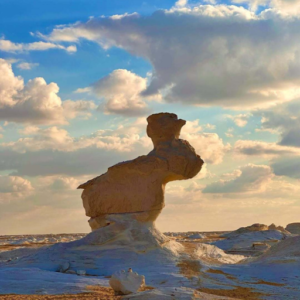
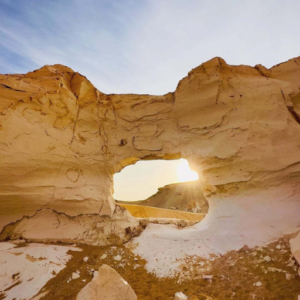
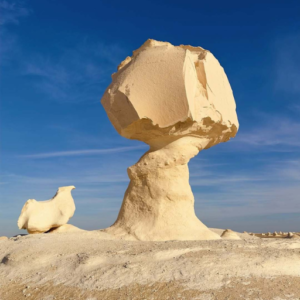
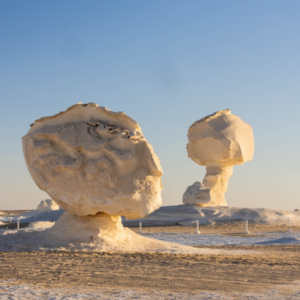
Its white chalk and limestone formations produce one of Egypt’s most unusual landscapes.
For the main destination page, see our White Desert Egypt Travel Guide.
You can also use our White Desert Camping Guide if you are unsure what sleeping overnight in the desert is really like.
How Many Days Do You Need for Bahariya and the White Desert?
2 Days
Best for travelers with limited time who want one White Desert camping night.
2 Days White Desert Tour from Cairo
3 Days
Better if you want a Bahariya hotel night plus White Desert camping.
3 Days White Desert Tour from Cairo
3-Day Adventure Option
For travelers who want more desert immersion and two camping nights:
3 Days White Desert Safari from Cairo
For comparison before booking, see our Best Western Desert Tours from Cairo.
3. Farafra Oasis
Best for Remote Landscapes and Longer Western Desert Routes
Farther south, Farafra Oasis offers a quieter and more remote experience.
Egypt’s official tourism authority describes Farafra as sitting in a Western Desert depression surrounded by the White Desert, Black Desert and Great Sand Sea.
Farafra is therefore closely linked to the geological landscapes that define much of Western Desert tourism.
But it also contains gardens, springs, historic remains and local settlements.
This makes it far more than a point on the road between the White Desert and Dakhla.
What Is Farafra Famous For?
Farafra is associated with:
- White Desert.
- Crystal Mountain.
- Agabat.
- Natural hot springs.
- Oasis gardens.
- Traditional settlements.
- Badr Museum.
- Qasr al-Farafra.
- Roman-era remains.
Experience Egypt specifically highlights Crystal Mountain, Agabat Valley, palm and fruit gardens and Bir Sitta hot spring among Farafra’s experiences.
Farafra Oasis Gardens
The gardens around Farafra provide one of the classic contrasts of oasis travel.
After hours of desert, visitors suddenly encounter palms, citrus, apricot, carob and olive trees.
The official tourism authority specifically highlights the oasis gardens as one of Farafra’s quieter attractions.
These landscapes help explain why oases functioned as important stopping points on long desert journeys.
Bir Sitta Hot Spring
Bir Sitta is one of Farafra’s best-known springs.
Experience Egypt recommends soaking there during the evening or at night, when the desert atmosphere and sky become part of the experience.
This is exactly the kind of stop that benefits from a longer itinerary.
A two-day White Desert tour needs to focus on the highlights.
A five- or eight-day Western Desert expedition has time for slower experiences.
How Do You Reach Farafra?
The Egyptian Tourism Authority gives Farafra’s road distance as approximately 545 km from Cairo and around 180 km from Bahariya.
That makes Farafra less suitable as a standalone weekend destination from Cairo.
Instead, include it naturally within a route such as:
Cairo → Bahariya → White Desert → Farafra → Dakhla → Kharga → Luxor
Our current 5 Days Western Desert Tour from Cairo to Luxor follows this broader route, continuing south from the White Desert through Farafra, Dakhla and Kharga before reaching Luxor.
4. Dakhla Oasis
Best for Traditional Architecture and Archaeology
Dakhla Oasis changes the character of a Western Desert journey.
In Bahariya and Farafra, geological landscapes often dominate the visitor experience.
In Dakhla, the relationship between human settlement and the desert becomes more important.
Egypt’s official tourism authority describes Dakhla as a green oasis with extensive agricultural land and a rich collection of temples, fortresses, villages and necropolises created by centuries of settlement and commercial activity.
For the full destination breakdown, read our Dakhla Oasis Egypt Guide.
What Is Dakhla Oasis Famous For?
Important sites include:
- Al-Qasr.
- Deir al-Hagar.
- Al-Muzawwaqa Necropolis.
- Ain Asil.
- Qila al-Dabba.
- Ezbet Bashendi.
- Traditional mud-brick architecture.
- Agricultural landscapes.
- Oasis villages.
Experience Egypt describes Dakhla’s archaeological record as including Roman tombs at al-Muzawwaqa, Old Kingdom remains at Ain Asil and Qila al-Dabba, Deir al-Hagar Temple and historic mud-brick villages.
Al-Qasr
Historic Al-Qasr is among Dakhla’s most atmospheric settlements.
Its narrow lanes, mud-brick buildings and traditional architecture offer a completely different visual experience from Cairo or Luxor.
For photographers, this is particularly important.
A Western Desert expedition is not only about sand.
One day you may photograph enormous white formations.
The next, you are walking through a centuries-old oasis settlement.
That diversity is why multi-oasis routes deserve more than a rushed itinerary.
Dakhla Archaeology
The archaeological record around Dakhla spans multiple historical periods.
At Deir al-Hagar, visitors encounter a well-preserved temple with Roman-period additions.
At Ain Asil and Qila al-Dabba, archaeological remains reach much further back.
At al-Muzawwaqa, Roman tombs preserve painted interiors.
These sites show that the Western Desert was never simply an empty borderland.
It supported settlements linked to wider commercial and administrative networks.
Who Should Visit Dakhla?
Dakhla is particularly good for:
- History lovers.
- Archaeology enthusiasts.
- Photographers.
- Slow travelers.
- Repeat Egypt visitors.
- Travelers crossing toward Kharga and Luxor.
It is not the first oasis I would recommend for a two-day Cairo trip.
It makes much more sense as part of a longer Western Desert itinerary.
5. Kharga Oasis
Best for Major Monuments and the Route to Luxor
Kharga is the southernmost of the principal oasis chain discussed here and historically one of the most important.
Egypt’s tourism authority describes Kharga as the largest of the four oases connected along the Western Desert highway and emphasizes its historical administrative significance.
It also has one major practical advantage for travelers:
Kharga can connect the Western Desert back toward Luxor and the Nile Valley.
For more detail, visit our Kharga Oasis Egypt Guide.
What Is Kharga Oasis Famous For?
The major attractions include:
- Hibis Temple.
- Al-Bagawat Necropolis.
- Al-Gheweta Temple.
- Qasr al-Zayan.
- Dush Temple.
- Roman fortifications.
- New Valley Museum.
- Springs.
- Desert landscapes.
Egypt’s official tourism authority calls Hibis the largest and best-preserved temple in Kharga and describes Al-Bagawat as one of the world’s oldest Christian burial grounds.
Hibis Temple
Hibis is one of the archaeological highlights of the entire oasis route.
Its construction and modification across multiple historical periods demonstrate how long Kharga remained strategically important.
Visiting it after several days of natural desert landscapes creates another dramatic change in the trip.
You begin with geology.
You finish with archaeology.
Al-Bagawat Necropolis
Al-Bagawat provides a very different perspective on Egypt’s religious history.
Rather than the pharaonic tombs normally associated with Luxor or Saqqara, the site contains early Christian burial structures.
That gives a multi-oasis Western Desert route significant historical depth.
Kharga and the Ancient Desert Roads
Kharga’s location helped turn it into an important desert crossroads.
This is one of the reasons the southern oases matter historically rather than simply geographically.
Modern travelers following Dakhla → Kharga → Luxor are moving through a landscape shaped by centuries of communication between the desert and Nile Valley.
Kharga to Luxor
Kharga makes an excellent final Western Desert stop because travelers can continue toward Luxor instead of returning to Cairo.
The official Egyptian Tourism Authority recommends considering links between Kharga and destinations such as Luxor and notes that the oasis is accessible by road.
Western Desert Travel uses this logic in our 5-Day Cairo to Luxor Western Desert Tour.
The route covers:
Cairo → Bahariya → White Desert → Farafra → Dakhla → Kharga → Luxor
instead of returning north after the desert safari.
Siwa vs Bahariya: Which Oasis Is Better?
This is probably the most useful comparison for first-time visitors.
Choose Siwa If You Want:
- Salt lakes.
- Ancient temples.
- Strong local culture.
- Hotels and eco-lodges.
- Great Sand Sea dunes.
- A 3–5 day destination.
Choose Bahariya If You Want:
- White Desert.
- Black Desert.
- Crystal Mountain.
- Agabat.
- Desert camping.
- A shorter trip from Cairo.
The simplest way to describe the difference is:
Siwa is primarily an oasis destination with a desert safari.
Bahariya is primarily an oasis gateway to a major desert safari.
Neither is universally better.
Bahariya vs Farafra
Choose Bahariya when:
- It is your first desert trip.
- You have 2–4 days.
- You are starting in Cairo.
- White Desert camping is the priority.
Choose Farafra when:
- You are continuing south.
- You have a longer itinerary.
- You want a more remote oasis.
- You want to connect the White Desert with Dakhla.
For most first-time travelers, Bahariya is more practical.
For expedition travelers, Farafra becomes much more interesting.
Dakhla vs Kharga
These oases work particularly well together.
Dakhla Is Stronger For:
- Mud-brick architecture.
- Historic settlements.
- Agricultural scenery.
- Archaeological variety.
Kharga Is Stronger For:
- Major temples.
- Early Christian heritage.
- Roman desert history.
- Continuing toward Luxor.
On a long route, there is little reason to choose between them.
Visit both.
What Is the Best Western Desert Oasis Route?
One of the strongest overland routes is:
Cairo → Bahariya → White Desert → Farafra → Dakhla → Kharga → Luxor
This makes geographical sense because you continue through the desert instead of returning to Cairo.
The route combines:
Bahariya oasis life.
Black Desert.
Crystal Mountain.
Agabat.
White Desert camping.
Farafra.
Dakhla archaeology.
Kharga monuments.
Luxor.
Our Western Desert Egypt Itinerary Guide compares this five-day option with shorter and longer routes.
For booking, use the 5 Days Western Desert Tour from Cairo to Luxor.
Can You Combine Siwa with the Other Western Desert Oases?
Yes, but the distances matter.
Siwa lies far northwest of the Bahariya–Farafra–Dakhla–Kharga corridor.
Trying to combine every oasis within one short trip would create far too much driving.
A more practical combined route is:
Cairo → El Alamein → Marsa Matrouh → Siwa → Bahariya → White Desert → Cairo
Western Desert Travel’s current 7 Days Siwa & White Desert Tour uses this broader structure, with nights in Marsa Matrouh, Siwa, Bahariya and the White Desert.
It is one of the strongest choices when you want both the cultural side of Siwa and the geological landscapes of the White Desert.
What About an 8-Day Western Desert Expedition?
If you want more than the classic oasis highway, a longer expedition can go considerably deeper.
Western Desert Travel’s current 8 Days Western Desert Expedition connects:
Kharga → Dakhla → Farafra → White Desert → Djara Cave → Agabat → Bahariya → Fayoum → Cairo
and includes hotel stays plus multiple camping sections.
This is much more suitable for:
- Repeat Egypt visitors.
- Serious photographers.
- Desert enthusiasts.
- Travelers comfortable with long road journeys.
- People who want the Western Desert to be a major part of the trip.
How Many Days Do You Need for the Western Desert Oases?
A practical guideline is:
2–3 Days
Bahariya + Black Desert + White Desert.
3–5 Days
Siwa Oasis.
5 Days
Bahariya + White Desert + Farafra + Dakhla + Kharga + Luxor.
7 Days
Siwa + Bahariya + White Desert.
8 Days or More
Multi-oasis expedition with remote desert locations such as Djara Cave and Fayoum.
The best duration depends on whether your main goal is one oasis, desert camping or a complete Western Desert journey.
What Is the Best Time to Visit the Western Desert Oases?
For most travelers, the cooler season provides the most comfortable conditions.
A useful general travel window is October through April.
This period is better suited to:
- Long sightseeing days.
- Archaeological exploration.
- 4×4 safaris.
- Hiking.
- Photography.
- Desert camping.
Winter nights can become cold, especially when camping, so warm layers remain important.
For a complete month-by-month breakdown, read our Best Time to Visit Western Desert Egypt.
Do You Need a 4x4 to Visit the Oases?
Not for every part of the trip.
Siwa, Bahariya, Farafra, Dakhla and Kharga are established settlements accessible by normal roads.
But reaching an oasis town is very different from traveling into remote desert terrain.
A 4×4 and experienced desert driver become important for locations such as:
- Great Sand Sea.
- Black Desert off-road areas.
- White Desert.
- Agabat.
- Remote springs.
- Djara Cave routes.
Experience Egypt specifically recommends using specialized and licensed operators for deeper desert exploration around Farafra.
Do not assume that because a destination appears on a digital map it is suitable for independent driving.
Which Western Desert Oasis Should You Choose?
Best First Oasis
Siwa if you want a complete destination.
Bahariya if you primarily want a desert safari.
Best for White Desert Camping
Bahariya.
Best for Culture
Siwa.
Best for Remote Atmosphere
Farafra.
Best for Historic Architecture
Dakhla.
Best for Major Archaeological Monuments
Kharga.
Best Multi-Oasis Route
Bahariya → Farafra → Dakhla → Kharga.
Plan Your Western Desert Oasis Tour
If you are still deciding, use this simple route selector.
Have 2 Days?
Choose:
2 Days White Desert Tour from Cairo
Have 3 Days?
Choose either:
or
Have 5 Days?
For Siwa:
For a multi-oasis expedition:
5 Days Western Desert Tour Cairo to Luxor
Have 7 Days?
7 Days Siwa & White Desert Tour
Want a Deeper Expedition?
8 Days Western Desert Expedition
You can also compare everything on the Western Desert Travel Tours Page.
Final Thoughts: Which Western Desert Oasis Is Best?
There is no single “best oasis in Egypt.”
There is a best oasis for your trip.
If you have limited time and want your first desert adventure, choose Bahariya and continue into the White Desert.
If you want a destination with culture, archaeology, salt lakes, hotels and enormous dunes, choose Siwa.
If you are traveling deeper through the Western Desert, add Farafra.
Then continue to Dakhla for traditional villages, agriculture and archaeological sites.
Finish with Kharga, where major monuments and ancient desert-road history provide a natural bridge back toward the Nile Valley and Luxor.
The most important thing to understand is that the oases are not five versions of the same landscape.
They complement one another.
Siwa shows the cultural and natural diversity of Egypt’s northwest.
Bahariya opens the route into the Black and White Deserts.
Farafra introduces a quieter and more remote Western Desert environment.
Dakhla reveals how agricultural communities and ancient settlements survived deep inside the desert.
Kharga demonstrates the enormous historical importance of the roads linking the Western Desert with the Nile Valley.
Together, these oases show why Egypt’s Western Desert deserves to be treated as a major travel region in its own right—not simply as a side trip from Cairo.
Western Desert Travel TripAdvisor reviews
We are proud to be trusted by travelers from the USA, UK, Europe, and expats living in Egypt.
Posted on Tripadvisor
 Nicholas B
Verified
Unforgettable experience My wife and I went on a safari with Western Desert travel and it was an amazing experience. The White Desert was enchanting, Crystal Mountain was breathtaking, and the Black Desert was a unique experience. The guides were professional and helpful, and the meals were delicious and fresh. I highly recommend this company to lovers of adventure, nature, and relaxation. Thank you for an unforgettable experience!Posted on Tripadvisor Gary S
Verified
Excellent service The White Desert tour with Western Desert travel Company was an unforgettable experience. Excellent organization and great service. Thank you!Posted on Tripadvisor Susan PAn amazing adventure An amazing experience! The White Desert tour with Western Desert travel Company was beyond wonderful. The rest at the camp was relaxing, and the meals were delicious. The activities were fun, like sandboarding and camping under the stars. The guides were professional and very helpful. I highly recommend this tour to adventure and nature lovers! ????Posted on Tripadvisor
 Fred AA perfect adventure for us As soon as we left Cairo behind and entered the vast expanse of the Western Desert, it felt like stepping into another dimension. The landscape slowly transformed from the bustling cityscape into endless golden dunes, rugged rock formations, and an overwhelming sense of serenity. Our first stop was Bahariya Oasis, a lush haven in the middle of the arid desert, where palm trees swayed gently in the breeze, and natural hot springs promised relaxation after a long journey.Posted on Tripadvisor
 Justin LA great experience in the White Desert Mohamed is an exceptional tour guide, polite, knowledgeable, and fluent in English. He is calm, well-educated, and makes the experience truly enjoyable. Our trip with him was nothing short of extraordinary! We explored incredible locations, including the Black Desert, once an area of active volcanic craters millions of years ago, the Crystal Zone with its dazzling natural crystals, and the breathtaking White Desert, where wind and time have sculpted the rocks into fascinating animal-like formations such as a snake, fish tail, camel, chicken, and rabbit.The scenery was mesmerizing, but the experience was made even better by the delicious, freshly prepared food. Every moment of the journey was enjoyable, and we were so captivated by the magic of the place that we decided to extend our stay for another night. What was planned as a one-night trip turned into two, simply because we couldn’t get enough of the stunning desert landscape.For anyone seeking a truly unique and unforgettable adventure, I highly recommend this tour with Western Desert Travel!Posted on Tripadvisor
 MakaylaAn authentic experience Our trip to the White and Black Deserts was nothing short of extraordinary! From the moment we set out, we were captivated by the breathtaking scenery—the golden dunes, the black volcanic hills, and the shimmering Crystal Mountain. But the true highlight was camping under a sky full of stars in the White Desert. The tranquility of the desert, combined with the warmth and hospitality of Mohamed and his team, made this experience unforgettable. The freshly prepared meals were delicious, and every detail of the trip was perfectly arranged. If you're looking for an adventure filled with beauty and serenity, this tour is an absolute must!Posted on Tripadvisor
 Bethany FUnforgettable trip in the desert Our camping trip in the White Desert was absolutely magical! From the moment we left Cairo, everything was smoothly organized—thanks to Mohamed and his incredible team. Driving through the Black Desert, marveling at Crystal Mountain, and feeling the golden dunes beneath our feet was breathtaking. But the real highlight was camping under the stars in the serene White Desert. The fresh dinner prepared by Mohamed’s team was beyond delicious, and the whole experience felt like a dream. Their hospitality, attention to detail, and passion for sharing this stunning landscape made this trip unforgettable We can't wait to return for a longer adventure!Posted on Tripadvisor
 Amelie BAn incredible experience This was hands down the best tour we've ever taken! Mohamed, our guide, was friendly, professional, and incredibly knowledgeable. From the moment we set foot in the Black Desert to watching the sunset over the White Desert’s surreal rock formations, every second was awe-inspiring. The landscape looked like something out of a painting, with towering chalk formations shaped by nature over millions of years. We loved the peacefulness of the desert, the delicious food, and the warm hospitality. Initially, we planned for just one night, but we were so enchanted that we extended our stay! Highly recommended for nature lovers and adventure seekers.Posted on Tripadvisor
 didiwadidiI loved this trip This was a trip I had been looking forward to for a long time. Mohamed's advice was invaluable while I was planning the trip. Once underway it was clear that he knew the area very well. Mohamed arranged for local guides to meet us when visiting historical sites. The accommodation was clean and comfortable and the food was excellent. The highlight for me was camping in the white desert, definitely an experience not to be missed. I have no hesitation in recommending Western Desert Travel.Below are the details of my trip:Day : 9 june Travel from Alexandria to Wadi Al Hitan to see the whale fossils. In the late afternoon proceed to Bahariya Oasis. Overnight at Bahariya. Day : 10 juneAfter the breakfast • local safari tour: through the old centre of the oasis, the black mountains, the sand dunes, salt lake, the gardens, pyramid mountain It is the place where the second largest dinosaur in the world was discovered. At sunset we go to the mountain with the ruin called "The English house" It is where the English lived in World War than back to the hotel for the diner. • In the evening there is a possibility to visit the village and the shopsDay : 11 June • After the breakfast we start the safari tour to the White Desert • (about 180 km.) This tour is going off and on road, with 4x4 cars. We will stop and drive to all the special areas between Bahariya and the White Desert , like: • the black desert • the valley of El Haize with the nice, warm spring; here we can have lunch. • the crystal mountains • the valley of l'Agabat Visit the Petrified Watermelon Valley overnight in this place and make the camping and cook frish food for dinner and Bedouin tea on fairDay : 12 juneAfter the breakfast Go for adventures among the dunes lunch time at the ( magic spring ) It is an enchanted Roman water spring. When you approach it, the water flows, and when you move away from it, the water stops and you visit the Roman cemetery. And lunch time than drive to Visiting petrified trees and petrified coral reefs and• the White Desert • We will make the safari camp in the White desert and cook a fresh meal for dinner. Day : 13 June • After breakfast we drive A tour in the White Desert to see chalk rocks of different shapes, such as the Sphinx, horse, chicken, elephant, rabbit than drive to farafa Oasis to visit Badr Museum drive to Dakhla Oasis, after lunch, going to visit Deir Al Hagar, the tombs of Qarat al Muzawaqqa and Al Qasr. Overnight in Dakhla in the hotelDay :14 June after breakfast drive to Kharga Oasis, visit Necropolis of Al Baghawat, the Temple of Hibis, Deir al Munira. will then proceed to Luxor.Posted on Tripadvisor
 PSFantastic Accompanied by an excellent, friendly, knowledgeable host and team. Travelling solo can be daunting in Egypt but they made me feel welcome and well looked after. The desert is just fantastic, and the camping experience very calming - all your problems go away. Muhammed is a great cook, very entertaining and thoughtful. The white desert is has an ethereal beauty, especially pretty at sunset. A must see
Frequently Asked Questions About Western Desert Oases Egypt
Discover the main Western Desert oases in Egypt, including Siwa, Bahariya, Farafra, Dakhla and Kharga, with practical answers about archaeology, camping, 4x4 travel, itineraries and the best time to visit.
Pingback: Best Time to Visit Siwa Oasis Egypt: 2026–2027 Weather Guide