
If you are searching for the best things to do in White Desert Egypt, the answer goes far beyond photographing a few unusual white rocks.
A typical White Desert journey takes you through several completely different landscapes in Egypt’s Western Desert. Within the same trip, you can climb dark desert hills, stop beside a natural spring, see sparkling Crystal Mountain, cross the golden dunes and white cliffs of the Valley of Agabat, watch sunset among surreal chalk formations, eat dinner around a campfire and sleep beneath an exceptionally dark desert sky.
That variety is exactly what makes the White Desert one of Egypt’s most distinctive outdoor experiences.
The White Desert Protectorate is a protected natural landscape famous for white chalk, limestone formations, dunes, fossils and rock sculptures shaped by erosion. Egypt’s Environmental Affairs Agency lists the protected area at approximately 3,133.5 square kilometers and identifies its chalk formations, fossils and unusual geological landscape among its most important natural features.
Egypt’s official tourism platform also describes the White Desert as an ancient seabed transformed into a natural gallery of wind-carved chalk sculptures, including the famous mushroom-shaped formations.
But the White Desert itself is only one part of the experience.
Most travelers approaching from Cairo first reach Bahariya Oasis and then continue by 4×4 through the Black Desert, El Haize, Crystal Mountain, the Valley of Agabat and finally the famous white formations.
This guide covers 15 of the best things to do in and around the White Desert, plus how many days you need, what route to choose, when to visit and how to organize the trip from Cairo.
For a broader introduction to the destination, read our complete White Desert Egypt travel guide.
Quick Answer: What Are the Best Things to Do in White Desert Egypt?
If you have limited time, these are the experiences you should prioritize:
- Explore the famous White Desert chalk formations.
- Discover the New White Desert.
- Visit the Old White Desert.
- Explore the Black Desert.
- Stop at Crystal Mountain.
- Cross the Valley of Agabat.
- Ride through the desert in a 4×4.
- Try sandboarding on the dunes.
- Stop at El Haize and a natural spring.
- Watch sunset in the desert.
- Camp overnight in the White Desert.
- Have dinner beside a desert campfire.
- Stargaze beneath the Western Desert sky.
- Watch sunrise over the chalk formations.
- Explore Bahariya Oasis before or after the safari.
For most first-time visitors, a 2-day, 1-night White Desert tour from Cairo provides the essential experience.
Travelers who have more time should consider three days because the slower schedule allows more time for photography, walking, additional formations and desert stops.
1. Explore the Famous White Desert Rock Formations
The main reason travelers come to the White Desert is its extraordinary landscape.
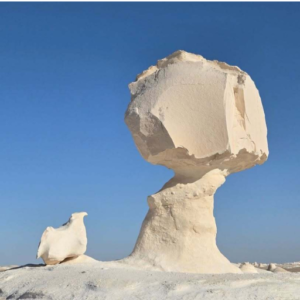
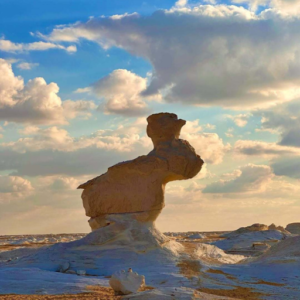
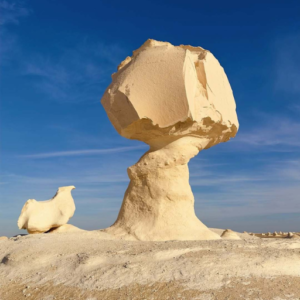
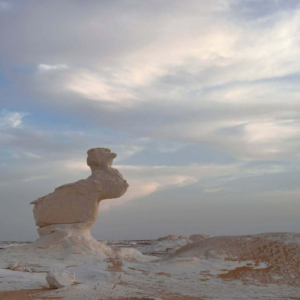
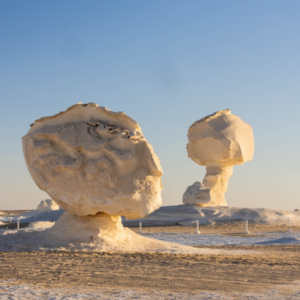
White chalk formations rise from golden and pale desert ground in shapes that can resemble mushrooms, towers, animals, icebergs or abstract sculptures.
They were not carved by people.
They are the result of natural geological and erosional processes acting over a very long period.
The Egyptian Environmental Affairs Agency describes the White Desert as an important example of karst landscape and notes its white chalk floor, limestone formations, fossils and wind-shaped chalk columns.
The official Experience Egypt tourism platform similarly describes the protectorate as a landscape of dunes, domes and wind-carved chalk sculptures originating from an ancient seabed.
This geological background helps explain why the White Desert looks so different from the classic image of a Sahara made entirely of endless sand dunes.
What Should You Look For?
Instead of searching only for one famous formation, look at the landscape as a whole.
Notice:
- Mushroom-shaped formations.
- Tall isolated chalk towers.
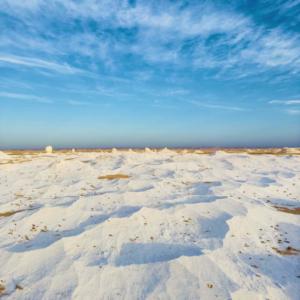
- Smooth white surfaces.
- Wind-polished shapes.
- White ground meeting golden sand.
- Fossil-bearing limestone.
- Changing shadows throughout the day.
The shapes also look dramatically different depending on the light.
At midday they can appear intensely white.
Around sunset they turn warmer.
Under moonlight, the landscape can look almost silver.
If photography is important to you, avoid treating the formations as a quick roadside stop.
Give yourself time to walk, change angles and watch the light move.
2. Discover the New White Desert
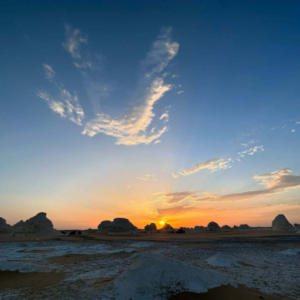
Many travelers hear the phrase New White Desert without realizing that White Desert safari routes can include more than one visually distinct area.
The New White Desert is famous for its dense concentration of dramatic standalone chalk formations.
This is the landscape most people imagine after seeing photographs of the White Desert online.
Large sculptural formations appear across the open desert with considerable space between them, creating one of the most surreal landscapes in Egypt.
It is also one of the most memorable places to camp.
Depending on your route, guide, conditions and permitted camping locations, the New White Desert may be visited during the late afternoon before camp is established nearby.
Best Time to Experience the New White Desert
Late afternoon is particularly beautiful.
Lower sunlight creates stronger shadows around the formations and helps reveal their texture.
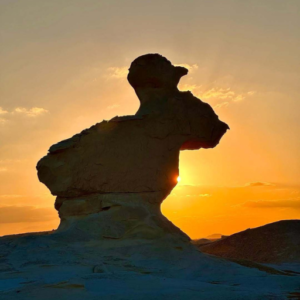
Sunset then transforms the white landscape into warmer shades before darkness arrives.
If you are choosing between a rushed visit and an overnight experience, the overnight trip wins easily.
You can read more about why in our guide to White Desert camping and what to expect.
3. Explore the Old White Desert
The Old White Desert provides another side of the region’s geology.
The landscape is not identical to the New White Desert, which is exactly why visiting both can make a longer safari more interesting.
Depending on the itinerary, guides may take travelers through older formations and different desert terrain before continuing to the more famous sculptural areas.
A good White Desert trip should not feel like driving directly to one rock, taking a photograph and turning around.
Part of the experience comes from watching the terrain change throughout the safari.
This is also one reason a three-day trip provides more depth than the fastest possible itinerary.
Our 3 Days White Desert Tour from Cairo provides additional time in Bahariya and the desert compared with the standard two-day route.
For travelers who want an even stronger emphasis on remote desert exploration, our 3 Days White Desert Safari from Cairo includes two nights of camping.
4. Explore the Black Desert
One of the best things about a White Desert safari is that you normally see much more than white terrain.
The Black Desert creates an immediate visual contrast.
Dark-covered hills rise from golden sand, giving the landscape a rougher and more dramatic appearance than the White Desert.
Most travelers visit it as one of the first major safari stops after leaving Bahariya Oasis.
You may stop at a viewpoint or climb one of the accessible hills depending on the route.
From above, the contrast between dark ridges and open desert is particularly impressive.
Egypt’s official tourism platform describes the Black Desert as a landscape of volcanic-shaped mountains scattered with black stones and lists it among the major desert excursions around Bahariya and Farafra.
Is the Black Desert Part of the White Desert?
They are separate landscapes but are commonly visited on the same Western Desert safari route.
That is why a traveler booking a White Desert trip from Cairo will often experience both.
Our Black Desert Egypt travel guide explains the location, landscape and how it fits into a combined desert safari.
5. Stop at Crystal Mountain
Crystal Mountain is one of the most famous stops between the Black Desert and White Desert.
Despite its name, it is not a massive mountain.
It is better understood as a small geological ridge or formation containing sparkling mineral deposits that reflect sunlight.
Egypt’s official tourism platform identifies Crystal Mountain as one of the geographical wonders accessible on desert excursions around Farafra.
Most visitors spend approximately 15–30 minutes exploring and photographing the formation rather than treating it as a standalone destination.
That is enough.
Crystal Mountain works because of its position within the route.
In one day, the scenery can change from:
Black hills
→ desert spring
→ crystalline formations
→ golden dunes and white cliffs
→ White Desert chalk sculptures.
That progression is one of the reasons the drive itself becomes part of the experience.
Read our complete Crystal Mountain Egypt guide before your trip.
Important Responsible Travel Tip
Do not remove crystals or damage the formation.
Natural desert landmarks should remain exactly where they are for future visitors.
6. Cross the Valley of Agabat
The Valley of Agabat, also spelled Aqabat or Agabat Valley, is one of the most dramatic landscapes on a White Desert safari.
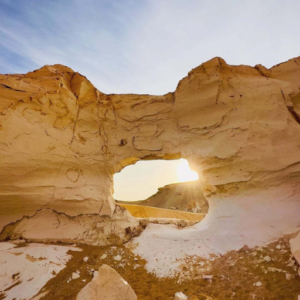
Large white cliffs and formations rise above soft golden sand, producing a completely different scene from both the Black Desert and the chalk fields of the White Desert.
Experience Egypt describes Aqabat Valley as an area famous for soft golden sand, dunes and signature white cliffs, with evidence of its ancient geological past still visible in the landscape.
For photographers, this may be one of the strongest stops on the entire route.
For adventure travelers, it is also where the scale of Egypt’s Western Desert becomes much more obvious.
You are no longer looking at a single rock formation beside a road.
You are surrounded by an enormous natural landscape.
Some itineraries also use the wider Agabat region for sandboarding or extended desert exploration depending on conditions.
Our 3 Days White Desert Safari from Cairo dedicates additional time to areas such as Agabat and desert springs rather than compressing everything into one afternoon.
7. Experience a Real 4x4 Desert Safari
You cannot separate the White Desert from the journey used to reach it.
Once you leave the main roads and continue into more remote terrain, an appropriate 4×4 safari vehicle becomes essential.
Desert driving is an experience of its own.
A knowledgeable driver understands:
- Sand conditions.
- Dune approaches.
- Tire pressure.
- Safe lines.
- Local tracks.
- Weather changes.
- Vehicle recovery.
- Route restrictions.
- Suitable stopping places.
Egypt’s official tourism information recommends arranging excursions through experienced licensed guides and appropriate 4×4 transportation, particularly for travel outside the oases.
This is not simply transportation from Attraction A to Attraction B.
The driving itself lets you experience huge areas that cannot be appreciated from a conventional paved road.
You move through open plains, dunes, rocky sections and increasingly remote landscapes.
Can You Drive to the White Desert Yourself?
Independent desert driving is not something first-time international visitors should improvise.
Access arrangements, permits and route rules can change, while remote sections have limited infrastructure and mobile coverage.
An organized desert safari removes much of that logistical burden.
For the full transport breakdown, read How to Get to the White Desert from Cairo.
8. Try Sandboarding in the Desert
Not every White Desert activity involves standing still and looking at rocks.
Depending on your tour route and current conditions, sandboarding can add a more active part to the safari.
The dunes around the wider Western Desert provide several suitable locations.
Egypt’s official tourism site specifically recommends sandboarding around Bahariya and mentions dune activities around the Farafra and Agabat region.
Beginners do not need previous snowboarding experience.
Your guide can choose an appropriate slope, and most people learn the basics quickly.
Expect to fall.
Expect sand in your shoes.
And expect at least one person in the group to attempt a very confident run that ends almost immediately.
What Should You Bring?
Secure:
- Phones.
- Cameras.
- Sunglasses.
- Loose objects.
Sand and electronics are not ideal partners.
If sandboarding is important to you, mention it when arranging your trip rather than assuming every route automatically includes it.
9. Stop at El Haize and a Natural Spring
Between Bahariya and the deeper desert landscapes, many routes include the El Haize area and a natural spring.
The stop provides a useful break after several hours of traveling.
Depending on the itinerary, travelers may stop for lunch, tea, a short rest or a chance to experience the water.
Natural hot and cold springs are part of the broader Bahariya desert environment. Egypt’s official tourism authority notes that hundreds of natural springs exist in and around Bahariya and highlights several of them among the oasis’s natural attractions.
Do not expect a luxury spa.
The attraction is the contrast.
You have been driving through an extremely dry landscape, and suddenly there is water, vegetation and a place to rest.
These changes are what make the Western Desert route interesting.
10. Watch Sunset in the White Desert
Sunset is one of the experiences that makes an overnight White Desert trip fundamentally different from a daytime visit.
As the sun gets lower, the desert becomes more three-dimensional.
Long shadows appear behind chalk formations.
White surfaces become cream, gold and pink.
The sky changes while the temperature begins dropping.
This is why your guide’s timing matters.
A good itinerary should leave enough time to reach the sunset area before the light disappears rather than racing toward camp after dark.
Best Sunset Photography Tip
Do not photograph only toward the sun.
Turn around.
The formations behind you may be catching the strongest warm light.
Also take:
- Wide landscape shots.
- Formation silhouettes.
- Close-up textures.
- Human-scale photos showing the size of the desert.
If photography is a priority, three or four days will generally give you more flexibility than the shortest itinerary.
11. Camp Overnight in the White Desert
If you do only one major activity in the White Desert, make it overnight camping.
Camping allows you to experience the destination during the three periods when it is arguably at its best:
Sunset.
Night.
Sunrise.
A typical organized camp may include:
- Tent or sleeping shelter.
- Mattress.
- Blankets or sleeping equipment.
- Dinner.
- Drinking water.
- Breakfast.
- Campfire.
- Guide and driver.
- Camping equipment.
The exact setup varies by operator, group size, season and weather conditions.
Our current 2 Days White Desert Tour from Cairo includes one overnight desert camp, while longer itineraries provide more time in the region.
If sleeping outdoors makes you nervous, read White Desert Camping: What to Expect before deciding.
You may also find our guide Is a White Desert Overnight Tour Worth It? useful if you are comparing the desert with other experiences in Egypt.
12. Have Dinner Around a Desert Campfire
Dinner in the desert is not about fine dining.
The location is what makes it memorable.
After sunset, the day’s driving stops.
The desert becomes quiet.
Dinner is prepared while travelers relax around camp.
Depending on the trip, meals can include simple Egyptian or Bedouin-style dishes prepared in the desert.
A warm meal feels particularly satisfying after hours of 4×4 driving, climbing viewpoints and walking through sand.
During colder months, the campfire also becomes the social center of the evening.
You talk.
Drink tea.
Review photographs.
Then gradually realize there is almost no city noise around you.
This slower part of the journey is easy to underestimate when choosing a tour from photographs online, but for many travelers it becomes one of their favorite moments.
13. Stargaze Under the Western Desert Sky
After dinner, look up.
The White Desert is far removed from Cairo’s urban light.
On a clear night, the difference in the sky can be dramatic.
Stars become one of the main attractions after the rock formations disappear into darkness.
You do not need professional astronomy equipment.
Simply move away from strong camp lighting where it is safe to do so and allow your eyes time to adjust.
For photographers, the landscape also creates opportunities to combine stars with chalk formations.
Best Conditions for Stargazing
Several factors matter:
- Cloud cover.
- Moon phase.
- Atmospheric conditions.
- Camp lighting.
- Time of night.
A bright full moon reduces the visibility of faint stars but can illuminate the white formations beautifully.
A darker moonless night creates a stronger stargazing experience.
Neither is automatically better.
They create different versions of the White Desert.
14. Wake Up for Sunrise
Do not sleep through sunrise.
Even if the previous day was long, wake up before or around first light.
The desert is usually cooler and extremely quiet.
As sunlight begins reaching the chalk formations, shadows slowly move across the ground and the landscape appears completely different from the previous evening.
Sunrise is also useful for photography because the light is softer than midday.
Afterward, breakfast is usually prepared before camp is packed and the return journey begins.
This is another reason the overnight White Desert experience is difficult to replace with a quick daytime visit.
Without camping, you miss sunset, night and sunrise—the three periods that give the White Desert much of its atmosphere.
15. Explore Bahariya Oasis
Do not think of Bahariya Oasis only as a transfer point.
For most short trips from Cairo, Bahariya is the gateway to the White Desert.
Egypt’s official tourism platform identifies Bahariya as the Western Desert oasis closest to Cairo and highlights its palm groves, springs, archaeological sites and access to both the Black and White Deserts.
Depending on the length of your trip, Bahariya can add:
- Palm groves.
- Natural springs.
- Local villages.
- Scenic viewpoints.
- Archaeological attractions.
- A hotel night between desert sections.
Our three-day itineraries allow more time in Bahariya than the standard two-day route.
Read our Bahariya Oasis Egypt guide if you are considering a longer stay.
What Is the Best White Desert Route from Cairo?
For most first-time travelers, the classic route is approximately:
Cairo → Bahariya Oasis → Black Desert → El Haize → Crystal Mountain → Valley of Agabat → White Desert → Bahariya → Cairo
The precise order can vary according to:
- Route conditions.
- Permit arrangements.
- Weather.
- Camping location.
- Group pace.
- Tour duration.
- Guide decisions.
This is important.
A desert safari should not be treated like a rigid city sightseeing bus itinerary where every stop occurs at exactly 11:15 AM.
Experienced guides may adjust the route to suit conditions.
For detailed transport planning, see our Cairo to White Desert guide.
How Many Days Do You Need in the White Desert?
The ideal duration depends on how deeply you want to explore.
2 Days / 1 Night
Best for:
- First-time visitors.
- Weekend trips.
- Travelers with limited time.
- One camping night.
- Main attractions.
A typical trip covers Bahariya, Black Desert, Crystal Mountain, Agabat and the White Desert before camping overnight.
See our 2 Days White Desert Tour
3 Days / 2 Nights
Best for:
- Slower travel.
- Photography.
- Additional desert time.
- Travelers who dislike rushing.
- More comfortable itineraries.
We currently offer two different approaches.
The 3 Days White Desert Tour from Cairo balances Bahariya accommodation with desert camping.
The 3 Days White Desert Safari focuses more strongly on the desert itself with two camping nights.
4 Days / 3 Nights
Best for:
- Desert enthusiasts.
- Longer exploration.
- Photography.
- Trekking-style experiences.
- Travelers making the Western Desert a major part of their Egypt trip.
Is a White Desert Day Trip from Cairo Possible?
Technically, you can travel long distances in one day.
That does not mean it produces a good White Desert experience.
The main road journey from Cairo to Bahariya itself takes several hours. Egypt’s official tourism guidance estimates around five hours for the drive to Bahariya, while White Desert excursions continue beyond the oasis.
Our current route normally involves approximately four to five hours between Cairo and Bahariya before the 4×4 safari begins.
Trying to go all the way into the White Desert and return to Cairo on the same day means sacrificing much of what makes the destination special.
You would likely miss:
- Sunset.
- Camping.
- Campfire dinner.
- Stargazing.
- Sunrise.
For most travelers, two days and one night is the shortest White Desert itinerary we recommend.
What Is the Best Time to Visit the White Desert?
The cooler months are generally the most comfortable period for desert travel.
Winter and the shoulder seasons make daytime sightseeing, walking and camping easier than the hottest part of summer.
However, desert temperatures change significantly between day and night.
A sunny afternoon can feel warm while the night becomes surprisingly cold.
For detailed month-by-month planning, read our Best Time to Visit White Desert Egypt.
Before departure, check the current forecast rather than relying only on annual averages.
What Should You Pack for the White Desert?
Keep your packing practical.
Useful items include:
- Comfortable clothing.
- Warm layer for night.
- Closed walking shoes.
- Sunglasses.
- Hat.
- Sunscreen.
- Personal medication.
- Power bank.
- Camera.
- Small backpack.
- Toiletries.
- Tissues and wet wipes.
- Reusable water bottle if desired.
Do not pack as though you are moving permanently into the Sahara.
Space inside safari vehicles matters.
Our dedicated White Desert Egypt packing list explains exactly what to bring for an overnight trip.
Is the White Desert Worth Visiting?
For travelers who enjoy nature and adventure, yes.
The strongest reason is variety.
A two- or three-day trip can combine landscapes that look completely unrelated:
Dark hills in the Black Desert.
A natural spring near El Haize.
Sparkling Crystal Mountain.
Golden sand and white cliffs in Agabat.
Sculptural chalk formations in the White Desert.
Then camping beneath the stars.
Few short trips from Cairo offer that level of landscape change.
The destination is particularly suitable for:
- Couples.
- Solo travelers joining suitable arrangements.
- Groups of friends.
- Photographers.
- Expats living in Cairo.
- Repeat visitors to Egypt.
- Travelers who want a break from archaeological sightseeing.
- Adventure-focused itineraries.
If you have already seen the Pyramids, museums and Nile Valley temples and want to experience an entirely different side of Egypt, the Western Desert is an excellent contrast.
How Much Does a White Desert Tour Cost?
The price depends on several factors:
- Private or shared arrangement.
- Number of travelers.
- Tour duration.
- Number of camping nights.
- Hotel accommodation.
- Pickup location.
- Included meals.
- Transport type.
- Itinerary.
- Additional activities.
Rather than adding a fixed price to an evergreen article that can become outdated, check our dedicated White Desert Tour Cost Guide and individual tour pages for current details.
You can also browse all Western Desert tours to compare itineraries.
Which White Desert Tour Should You Choose?
Choose 2 Days if:
You want the essential White Desert experience in the shortest practical time.
2 Days White Desert Tour from Cairo
Choose 3 Days with Hotel + Camping if:
You want a more balanced trip with additional comfort and time in Bahariya.
3 Days White Desert Tour from Cairo
Choose a 3-Day Safari if:
Your priority is desert exploration and you want two camping nights.
3 Days White Desert Safari from Cairo
Choose 4 Days if:
The desert is one of the main reasons for your trip to Egypt and you want deeper exploration.
4 Days White Desert Tour from Cairo
Still Comparing?
Read Best White Desert Tours from Cairo before choosing.
Final Thoughts: What Should You Not Miss in the White Desert?
If this is your first White Desert trip, do not focus only on finding the most famous mushroom-shaped rock.
The best experience comes from the journey as a whole.
Leave Cairo early.
Reach Bahariya.
Watch the landscape become darker in the Black Desert.
Stop at Crystal Mountain.
Cross the huge scenery of the Valley of Agabat.
Drive deeper into the Western Desert.
Explore the chalk formations.
Watch sunset.
Eat beside a campfire.
Look at the stars.
Sleep in the desert.
Then wake up for sunrise.
That sequence is what turns the White Desert from a geological attraction into one of Egypt’s most memorable adventures.
If you only have two days, focus on the classic route and one camping night.
If you have three days, slow down and explore more.
If you have four days, allow the desert itself to become a major part of your Egypt itinerary.
For trip options, compare all our White Desert and Western Desert tours.
Western Desert Travel TripAdvisor reviews
We are proud to be trusted by travelers from the USA, UK, Europe, and expats living in Egypt.
Posted on Tripadvisor
 Nicholas B
Verified
Unforgettable experience My wife and I went on a safari with Western Desert travel and it was an amazing experience. The White Desert was enchanting, Crystal Mountain was breathtaking, and the Black Desert was a unique experience. The guides were professional and helpful, and the meals were delicious and fresh. I highly recommend this company to lovers of adventure, nature, and relaxation. Thank you for an unforgettable experience!Posted on Tripadvisor Gary S
Verified
Excellent service The White Desert tour with Western Desert travel Company was an unforgettable experience. Excellent organization and great service. Thank you!Posted on Tripadvisor Susan PAn amazing adventure An amazing experience! The White Desert tour with Western Desert travel Company was beyond wonderful. The rest at the camp was relaxing, and the meals were delicious. The activities were fun, like sandboarding and camping under the stars. The guides were professional and very helpful. I highly recommend this tour to adventure and nature lovers! ????Posted on Tripadvisor
 Fred AA perfect adventure for us As soon as we left Cairo behind and entered the vast expanse of the Western Desert, it felt like stepping into another dimension. The landscape slowly transformed from the bustling cityscape into endless golden dunes, rugged rock formations, and an overwhelming sense of serenity. Our first stop was Bahariya Oasis, a lush haven in the middle of the arid desert, where palm trees swayed gently in the breeze, and natural hot springs promised relaxation after a long journey.Posted on Tripadvisor
 Justin LA great experience in the White Desert Mohamed is an exceptional tour guide, polite, knowledgeable, and fluent in English. He is calm, well-educated, and makes the experience truly enjoyable. Our trip with him was nothing short of extraordinary! We explored incredible locations, including the Black Desert, once an area of active volcanic craters millions of years ago, the Crystal Zone with its dazzling natural crystals, and the breathtaking White Desert, where wind and time have sculpted the rocks into fascinating animal-like formations such as a snake, fish tail, camel, chicken, and rabbit.The scenery was mesmerizing, but the experience was made even better by the delicious, freshly prepared food. Every moment of the journey was enjoyable, and we were so captivated by the magic of the place that we decided to extend our stay for another night. What was planned as a one-night trip turned into two, simply because we couldn’t get enough of the stunning desert landscape.For anyone seeking a truly unique and unforgettable adventure, I highly recommend this tour with Western Desert Travel!Posted on Tripadvisor
 MakaylaAn authentic experience Our trip to the White and Black Deserts was nothing short of extraordinary! From the moment we set out, we were captivated by the breathtaking scenery—the golden dunes, the black volcanic hills, and the shimmering Crystal Mountain. But the true highlight was camping under a sky full of stars in the White Desert. The tranquility of the desert, combined with the warmth and hospitality of Mohamed and his team, made this experience unforgettable. The freshly prepared meals were delicious, and every detail of the trip was perfectly arranged. If you're looking for an adventure filled with beauty and serenity, this tour is an absolute must!Posted on Tripadvisor
 Bethany FUnforgettable trip in the desert Our camping trip in the White Desert was absolutely magical! From the moment we left Cairo, everything was smoothly organized—thanks to Mohamed and his incredible team. Driving through the Black Desert, marveling at Crystal Mountain, and feeling the golden dunes beneath our feet was breathtaking. But the real highlight was camping under the stars in the serene White Desert. The fresh dinner prepared by Mohamed’s team was beyond delicious, and the whole experience felt like a dream. Their hospitality, attention to detail, and passion for sharing this stunning landscape made this trip unforgettable We can't wait to return for a longer adventure!Posted on Tripadvisor
 Amelie BAn incredible experience This was hands down the best tour we've ever taken! Mohamed, our guide, was friendly, professional, and incredibly knowledgeable. From the moment we set foot in the Black Desert to watching the sunset over the White Desert’s surreal rock formations, every second was awe-inspiring. The landscape looked like something out of a painting, with towering chalk formations shaped by nature over millions of years. We loved the peacefulness of the desert, the delicious food, and the warm hospitality. Initially, we planned for just one night, but we were so enchanted that we extended our stay! Highly recommended for nature lovers and adventure seekers.Posted on Tripadvisor
 didiwadidiI loved this trip This was a trip I had been looking forward to for a long time. Mohamed's advice was invaluable while I was planning the trip. Once underway it was clear that he knew the area very well. Mohamed arranged for local guides to meet us when visiting historical sites. The accommodation was clean and comfortable and the food was excellent. The highlight for me was camping in the white desert, definitely an experience not to be missed. I have no hesitation in recommending Western Desert Travel.Below are the details of my trip:Day : 9 june Travel from Alexandria to Wadi Al Hitan to see the whale fossils. In the late afternoon proceed to Bahariya Oasis. Overnight at Bahariya. Day : 10 juneAfter the breakfast • local safari tour: through the old centre of the oasis, the black mountains, the sand dunes, salt lake, the gardens, pyramid mountain It is the place where the second largest dinosaur in the world was discovered. At sunset we go to the mountain with the ruin called "The English house" It is where the English lived in World War than back to the hotel for the diner. • In the evening there is a possibility to visit the village and the shopsDay : 11 June • After the breakfast we start the safari tour to the White Desert • (about 180 km.) This tour is going off and on road, with 4x4 cars. We will stop and drive to all the special areas between Bahariya and the White Desert , like: • the black desert • the valley of El Haize with the nice, warm spring; here we can have lunch. • the crystal mountains • the valley of l'Agabat Visit the Petrified Watermelon Valley overnight in this place and make the camping and cook frish food for dinner and Bedouin tea on fairDay : 12 juneAfter the breakfast Go for adventures among the dunes lunch time at the ( magic spring ) It is an enchanted Roman water spring. When you approach it, the water flows, and when you move away from it, the water stops and you visit the Roman cemetery. And lunch time than drive to Visiting petrified trees and petrified coral reefs and• the White Desert • We will make the safari camp in the White desert and cook a fresh meal for dinner. Day : 13 June • After breakfast we drive A tour in the White Desert to see chalk rocks of different shapes, such as the Sphinx, horse, chicken, elephant, rabbit than drive to farafa Oasis to visit Badr Museum drive to Dakhla Oasis, after lunch, going to visit Deir Al Hagar, the tombs of Qarat al Muzawaqqa and Al Qasr. Overnight in Dakhla in the hotelDay :14 June after breakfast drive to Kharga Oasis, visit Necropolis of Al Baghawat, the Temple of Hibis, Deir al Munira. will then proceed to Luxor.Posted on Tripadvisor
 PSFantastic Accompanied by an excellent, friendly, knowledgeable host and team. Travelling solo can be daunting in Egypt but they made me feel welcome and well looked after. The desert is just fantastic, and the camping experience very calming - all your problems go away. Muhammed is a great cook, very entertaining and thoughtful. The white desert is has an ethereal beauty, especially pretty at sunset. A must see
Frequently Asked Questions About Things to Do in White Desert Egypt
Plan your White Desert Egypt adventure with practical answers about safari activities, camping, travel from Cairo, Crystal Mountain, the Black Desert, Valley of Agabat and what to pack.
Pingback: Western Desert Egypt: Best Places to Visit & Travel Guide
Pingback: Western Desert Egypt Itinerary: 3, 5, 7 & 8-Day Routes